Buying a Used Honda in Kenya: What to Check Before You Pay
Hondas are among the most common used cars on Kenyan roads. The Fit, Fit Shuttle, Vezel, Grace, Freed, CR-V and Civic are all popular for the same reasons: they are economical, practical and, when looked after, dependable. That popularity also means there are many tired, poorly repaired and badly documented examples for sale alongside the good ones.
This guide is for anyone buying a used Honda in Kenya, whether from a yard, a private seller or a fresh import. It walks through the paperwork to check before you even see the car, what to look for on the walk-around and test drive, the model-specific points that matter most for popular Hondas, and the red flags that should make you walk away.
No checklist replaces a proper inspection by someone who works on these cars every day. What this guide will do is help you filter out bad cars early, ask sellers the right questions, and understand what an inspection report is telling you.
Fresh Import or Locally Used: What Changes
Most used Hondas in Kenya fall into one of two groups.
Fresh imports have recently arrived, usually from Japan, and have not been registered in Kenya before. They have import paperwork, often including an auction sheet from Japan, and they have not yet been exposed to Kenyan roads and fuel. Their risks are mostly hidden ones: mileage that cannot be independently confirmed, accident repairs done before export, and service history that ends at the port.
Locally used cars have already been registered and driven in Kenya. They have a Kenyan ownership history you can partly verify, and sometimes local service records. Their risks are more visible: wear from local roads, repairs of unknown quality, a history of fluid top-ups with whatever was available, and in some cases a loan still registered against the car.
Both can be good buys. The checks below apply to both, with some points more important for one than the other.
Check the Paperwork Before You Check the Car
Mechanical problems can be fixed. Paperwork problems can cost you the car. Do these checks first, because they can end the conversation before you spend money on an inspection.
The NTSA copy of records
For any locally registered car, get the official record from the National Transport and Safety Authority. NTSA has advised buyers to search through its service portal and obtain a copy of the vehicle records before committing to buy. The record shows the registered owner and the vehicle details.
Compare it carefully with what the seller tells you and with the car itself:
- Does the registered owner match the person selling, and does their ID match?
- Do the chassis and engine numbers on the record match the numbers on the car?
- Is there a financier or charge registered against the car? If so, a lender may have rights over it until the loan is cleared.
- Do the make, model, colour and engine capacity match?
If the seller will not let you do this check, or keeps finding reasons to delay it, treat that as your answer.
The 8-year rule and why it matters to buyers
Kenya limits used car imports under KS 1515:2000, the Kenya Bureau of Standards code of practice for inspection of road vehicles. KEBS states that imported used vehicles must not be more than eight years old from the year of first registration. For 2026, KEBS announced that only right hand drive vehicles first registered from 1 January 2019 onwards would be allowed in, as reported by Kenyans.co.ke.
This matters even if you are buying a car that is already here. It explains why prices of older models behave the way they do, and why some sellers of fresh imports push hard to close deals near the cut-off. If you are buying a car that has not yet cleared, confirm with the importer that it qualifies under the current rules before you pay any deposit.
Import documents for fresh imports
For a fresh import, ask to see the export or deregistration certificate from the country of origin and the Certificate of Roadworthiness. KEBS requires vehicles from countries where it has an inspection agency, including Japan, to come with a Certificate of Roadworthiness issued by its contracted inspection company. Check that the chassis number on every document matches the car.
If the car came through a Japanese auction, ask for the auction sheet. It records the grade the auction house gave the car, its recorded mileage at sale and notes about damage or repairs. Treat it as useful evidence, not a guarantee. Compare what it says with what you see, and be wary of a sheet that cannot be traced back to a real auction record.
Service history
Ask for every service receipt the seller has. For a locally used car, receipts from a known garage showing regular oil changes, transmission fluid changes and brake work are worth a lot. Gaps are normal. A complete absence of records on a car described as “well maintained” is not.
Know Exactly Which Honda You Are Looking At
Many Honda nameplates in Kenya cover several versions with different engines and gearboxes. Before you inspect the car, confirm which version it is from the chassis number and the model details. It changes what you need to check.
The most important distinction is between petrol and hybrid versions of the same model. Petrol Fits and Vezels from the generation launched around 2013 generally use a CVT. The hybrid Fit and Vezel from that generation use Honda’s i-DCD system, which pairs the engine and an electric motor with a 7-speed dual clutch transmission, as described in Honda’s own announcement. The system also uses a lithium-ion battery. Those are very different gearboxes with different faults and different service needs.
Trim level matters too. Higher trims may add features such as driver assistance systems, electric seats or navigation units that need checking. Make sure the features the seller advertises are actually fitted and working.
The Walk-Around: Body, Rust and Accident Signs
Inspect the car in daylight, on level ground, and when it is dry. Rain and poor light hide a lot.
- Panel gaps. Look along the gaps between the bonnet and wings, doors and body, and boot and rear panels. Uneven or inconsistent gaps can mean accident repair.
- Paint. Look along each side at an angle. Differences in colour or texture between panels, overspray on rubber seals or trim, and paint on bolt heads all suggest repainting.
- Bolts and brackets. Under the bonnet, look at the bolts holding the wings, bonnet hinges and front panel. Tool marks or mismatched bolts suggest parts have been removed or replaced.
- Glass. Check the markings on each window. Mismatched brands can indicate a replaced window, which may or may not matter.
- Underside. Look for bent components, fresh welding, heavy rust or signs of damage from rough roads. Check the sills and the floor of the boot under the mat.
- Tyres. Uneven wear across a tyre can mean alignment problems or suspension damage. Tyres from different brands on the same axle suggest a car that has been maintained cheaply.
Under the Bonnet
You do not need to be a mechanic to spot warning signs under the bonnet. Look for:
- Leaks. Oil around the engine, coolant residue near the radiator and hoses, or fluid around the gearbox.
- Engine oil. Check the dipstick. Very dark, thick oil suggests overdue changes. Milky or foamy residue under the oil filler cap can indicate coolant mixing with oil, which needs investigating.
- Coolant. The reservoir should be at the correct level with clean coolant. Rusty or oily coolant is a warning sign. Our article on why cleaning your coolant radiator matters explains why cooling system condition is so important.
- A suspiciously clean engine bay. A freshly washed engine on an otherwise ordinary car can be innocent, but it can also hide leaks. Ask when it was cleaned.
- Wiring. Look for cut wires, taped joints or added wiring from alarms, trackers or audio systems. Poorly installed accessories cause electrical faults later.
Start the Engine From Cold
Ask the seller not to start the car before you arrive, and put your hand on the bonnet when you get there. A warm engine can hide starting problems, noises and smoke that only appear from cold.
When it starts, listen for rattles in the first few seconds, knocking, or uneven running. Look at the exhaust for blue smoke, which suggests oil burning, or persistent white smoke with a sweet smell, which can indicate coolant entering the engine. All warning lights on the dashboard should come on briefly when the ignition is switched on and then go off after the engine starts. A warning light that never comes on at all may have been disconnected.
The Test Drive That Actually Tells You Something
A lap around the yard tells you almost nothing. Insist on at least 20 minutes on real roads, and try to include each of these:
- Slow traffic or a quiet road at crawling speed. This is where CVT judder, dual clutch hesitation and jerky low speed behaviour show up.
- A hill. Pulling away on an incline tests the gearbox and, on i-DCD hybrids, how the car handles take-off without rolling back.
- A stretch at 80 km/h or more. Listen for wind noise, droning, wheel bearing hum and vibration through the steering wheel.
- A rough section or speed bumps. Knocks and clunks point to worn suspension links, bushes or mountings. Our guide to engine and gearbox mountings replacement explains what worn mounts sound like.
- Firm braking from moderate speed where it is safe to do so. The car should stop straight, without pulling or pedal vibration.
- Full steering lock in both directions at low speed. Clicking noises can indicate worn driveshaft joints.
During the drive, test the air conditioning at full cold, the power windows, the mirrors, the central locking, the reversing camera if fitted and the infotainment unit. Small faults add up, and they are useful when negotiating the price.
[IMAGE SUGGESTION: Buyer and technician on a test drive in a Honda Fit, technician holding a scan tool displaying live data]
A test drive with a scan tool connected shows how the engine and gearbox behave under real conditions, not just at idle.
Model-Specific Checks for Popular Hondas
Petrol Honda Fit, Fit Shuttle and Vezel
For CVT-equipped petrol models, focus on the gearbox during the test drive. Low speed judder under light acceleration, a delay when selecting Drive or Reverse, a whine that rises with road speed, or engine revs flaring without the car accelerating are all reasons for a closer look. Ask when the CVT fluid was last changed and what fluid was used. If nobody knows, budget for a fluid service with the correct fluid after purchase. Our guide to Honda CVT problems explains each symptom in detail.
Also check the common items raised in our article on common Honda Fit and Fit Shuttle problems, including air conditioning performance, suspension noises and ABS warning lights.
Fit Hybrid, Vezel Hybrid and other i-DCD hybrids
These cars need two extra checks: the dual clutch transmission and the hybrid battery.
Transmission. Honda recalled early production Fit Hybrid and Vezel Hybrid cars in Japan three times between October 2013 and February 2014 over software controlling the 7-speed DCT. Honda’s recall notice describes symptoms including gears not engaging, delays in pulling away and, in some cases, the car being unable to move. Most cars covered by those recalls are now older than cars being imported, but they are still on Kenyan roads as locally used cars. For any i-DCD hybrid, pay close attention to how it pulls away from rest, how it behaves in crawling traffic, and whether it hesitates or jerks between gears. A flashing transmission warning or a service message on the display needs investigation before purchase.
Hybrid battery. The i-DCD system uses a lithium-ion battery. Battery health affects fuel economy, electric-only driving and overall performance, and replacement or reconditioning is a significant cost. During the test drive, notice whether the car uses electric power at low speed and whether the battery charge display behaves sensibly. A diagnostic scan can read hybrid system data and stored faults, which gives a much better picture than a test drive alone. If the model has a battery cooling air intake inside the cabin, make sure it is not blocked by bags or seat covers, because cooling affects battery life.
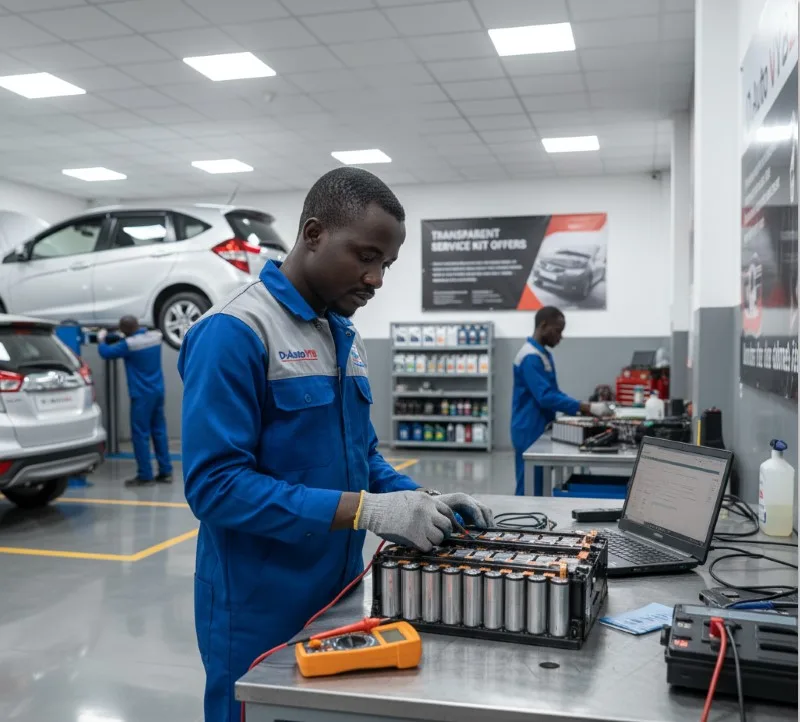
Hybrid battery condition is one of the biggest cost variables when buying a used Honda hybrid.
For more on this, see our articles on common Honda Vezel problems in Kenya and Honda Vezel hybrid battery reconditioning.
Honda CR-V
The CR-V is larger and heavier, and many examples have been used for family trips and rough roads. Pay extra attention to suspension noises, tyre wear, the condition of the underbody and the gearbox behaviour under load. On four wheel drive versions, ask whether the rear differential fluid has ever been changed, and listen for groaning or shuddering when turning tightly at low speed. Check the air conditioning thoroughly, as a weak system in a large cabin is quickly noticeable in Nairobi afternoons.
Honda Civic and Freed
For these and other Honda models, the same principles apply: confirm the exact version, check the gearbox type, and look for the problems covered in our article on common Honda Freed and Civic problems. On the Freed, test both sliding doors several times, including the powered ones if fitted, because door mechanisms are expensive to repair.
What a Diagnostic Scan Adds
A visual inspection and test drive tell you a lot. A diagnostic scan tells you what the car’s own computers have recorded. A proper scan reads every control unit, not just the engine, and can show:
- Stored fault codes, including ones that have not yet switched on a warning light.
- Signs that codes were recently cleared, which some sellers do shortly before a viewing.
- Live data such as engine temperature, fuel trims, transmission behaviour and, on hybrids, battery information.
- Airbag system faults, which should never be ignored on a family car.
If you want to understand what a scan involves, our guide on how much a car diagnostic costs covers the basics.
Flood Cars, Wound-Back Mileage and Other Traps
Some problems are deliberately hidden. Watch for these.
Flood or water damage
Water damage causes electrical faults that can appear months later. Warning signs include a damp or musty smell, new carpets in an older car, rust on seat mounting bolts or under the dashboard, water marks inside the boot or lights, and silt in hard-to-clean places such as under the spare wheel.
Mileage that does not add up
An odometer reading can be altered. Compare the recorded mileage with the overall condition of the car. A worn steering wheel, shiny gear knob, sagging driver’s seat and worn pedal rubbers on a car showing very low mileage do not fit together. Compare the reading with the auction sheet, service receipts and any stickers from previous oil changes.
Cleared warning lights
A warning light can be switched off by clearing codes, disconnecting the battery or, in the worst cases, removing the bulb or disconnecting the warning. That is why the bulb check at ignition and a proper scan both matter.
Pressure to decide quickly
“Another buyer is coming this afternoon” is one of the oldest lines in car sales. A good car at a fair price will still be a good car after an inspection. If a seller refuses to allow one, that tells you something.
Red Flags That Should Make You Walk Away
- The seller’s name and ID do not match the NTSA record, and there is no convincing, documented explanation.
- Chassis or engine numbers are damaged, altered or do not match the documents.
- A loan or charge is registered against the car and the seller cannot show how it will be cleared before transfer.
- The seller refuses an independent inspection or a proper test drive.
- Clear signs of flood damage.
- Evidence of major structural accident repair, such as uneven gaps across the whole front, fresh welding on chassis rails or airbag warning faults.
- A slipping or clunking gearbox, or a hybrid showing system warnings, when the price assumes the car is healthy.
Budget for the First Service After Purchase
Even a good used car usually needs attention soon after you buy it, simply because you cannot be sure what was done before. A sensible first service often includes engine oil and filter, air and cabin filters, a check of brake fluid and coolant condition, a transmission fluid check or change with the correct fluid, and an inspection of the brakes, suspension and tyres. On an older car, spark plugs may also be due.
Setting money aside for this is part of buying well. It resets the maintenance history, and it gives you a baseline for future servicing. Our article on what it costs to service a Honda in Nairobi can help you plan for it.
Paying and Transferring Ownership Safely
Once you are satisfied with the car, protect yourself at the payment stage. Use a traceable payment method rather than a large cash payment, write a simple sale agreement that lists the chassis and engine numbers, and make sure the transfer of ownership is done through the official NTSA process on eCitizen. The seller starts the transfer and the buyer accepts it from their own account. Keep copies of every document and receipt.
Frequently Asked Questions
Is a used Honda Vezel Hybrid a good buy in Kenya?
It can be, if it has been maintained and its dual clutch transmission and hybrid battery are in good condition. Those two systems are where the biggest costs sit, so a used Vezel Hybrid should always be scanned and road tested properly before purchase. A cheap example with a weak battery or gearbox faults can quickly become an expensive one.
What is the most important check when buying a used car in Kenya?
The ownership record comes first. Get the NTSA copy of records and confirm that the owner, chassis number, engine number and any registered charges match what the seller is telling you. A mechanically perfect car with a paperwork problem is still a bad buy.
Can I still import a 2018 Honda?
According to KEBS announcements, from 1 January 2026 only right hand drive vehicles first registered from 1 January 2019 onwards are eligible for import under the eight year rule. Import rules can change, so confirm the current position with KEBS or a licensed importer before paying for a car that has not yet been shipped.
How can I check a hybrid battery before buying?
A test drive gives some clues, such as whether the car uses electric power at low speed and whether the charge display behaves normally. A diagnostic scan by a technician who works on Honda hybrids gives far better information, including stored faults and battery data.
Should I trust the Japanese auction sheet?
It is useful evidence, especially for mileage at the time of sale and noted damage. It is not a guarantee. Compare it with the car’s actual condition and have the car inspected regardless.
Is a locally used Honda better than a fresh import?
Neither is automatically better. A fresh import has not been exposed to local roads and fuel but has less verifiable history. A locally used car has more history you can check but may have local wear and repairs of unknown quality. Judge the individual car, not the category.
What does a pre-purchase inspection cover?
It typically covers the body, underside, engine, gearbox, suspension, brakes, electrical systems and a diagnostic scan, followed by a road test. The aim is to tell you what condition the car is really in and what it is likely to need soon, so you can decide whether to buy and at what price.
Get the Car Inspected Before You Commit
Buying a used Honda in Kenya does not need to be a gamble. Check the paperwork first, know exactly which version you are looking at, test the car properly, and look hardest at the systems that cost the most to fix: the gearbox and, on hybrids, the battery. Most bad purchases happen because a buyer skipped one of those steps under time pressure.
Before you hand over any money, have the car checked by someone who knows Hondas. DOHC Auto offers pre-purchase inspections for imports along with Honda diagnostics and servicing, from Mirema Lane opposite PAC University. Contact DOHC Auto to arrange an inspection of the Honda you are thinking of buying.